Uncategorized
Jev AI vs LLMs: When Should You Use a Decision Model Instead of a Chat Model?
Jev AI and large language models are not simple substitutes. Compare output shape, latency, uncertainty, engineering complexity, and safety boundaries to decide when a decision model is the better fit.

Jev AI vs LLMs: When Should You Use a Decision Model Instead of a Chat Model?
When teams first encounter Jev AI, they often ask a practical question: How is Jev different from ChatGPT, Claude, or another large language model? If an LLM can already return JSON, why add a separate decision model?
The answer is not that “Jev AI is always better.” The systems are optimized for different jobs. LLMs are strong at open-ended generation, explanation, and complex reasoning. Jev AI is designed to turn a piece of state into a choice, score, or yes/no judgment within a defined answer space, then hand the result back to application code.
This guide compares Jev AI with generative LLMs from an engineering perspective, provides a practical selection framework, and explains how both can work together inside one agent or SaaS workflow.
Quick answer: If you can define the answer space in advance and the result needs to be reused, ranked, routed, or blocked by code, evaluate Jev AI first. If the task requires writing, explanation, creativity, or open-ended reasoning, keep using a generative LLM.
Table of contents
- The fundamental difference
- Five dimensions for comparison
- When to prefer Jev AI
- When an LLM is still the right choice
- How Jev AI and LLMs can work together
- How to design an evaluation
- Frequently asked questions
The fundamental difference

Image: An LLM primarily produces content for people, while Jev AI primarily returns decisions for software.
An LLM is a generator; Jev is a decision layer
Generative LLMs produce the next token from context. They can write an email, explain code, summarize a report, or generate JSON through prompting. But that JSON is still the result of text generation. The application must validate fields, handle missing values, and account for formatting drift.
Jev AI starts with the question type. You define whether the application needs a Choice, Score, or Noul judgment, then provide State. The response is organized around choices, scores, yes/no judgments, probabilities, and confidence. Jev is not simply a smaller chat model; it treats software judgment as a first-class interface.
Does the result need to return to code?
If a person will read the output and decide what to do, text is often appropriate. If the output should enter an if statement, queue, router, permission check, or tool call, a stable decision shape matters more.
That is the central idea in the Jev AI introduction: Jev makes the judgment, while application code makes the move.
Five dimensions for comparison
| Dimension | Jev AI | Generative LLM |
|---|---|---|
| Main output | Choice, Score, Noul, probabilities, and confidence | Text, code, explanations, or open-ended structured content |
| Answer space | Defined by the developer | Usually open-ended and prompt-dependent |
| Best control flow | Classification, routing, ranking, blocking, escalation | Generation, summarization, explanation, planning, creation |
| Uncertainty | Explicit probability and confidence signals | Usually requires extra validation or a second judgment |
| System role | A decision node inside business logic | A content or reasoning center |
1. Does the output need to be executable?
Support routing, model selection, risk escalation, and pre-tool checks are not requests for beautiful prose. They need a result that tells a program which path to take. Parsing natural language for every request adds complexity as traffic grows.
Jev AI is designed to keep this layer close to application inputs. An LLM can also use function calling and JSON Schema, but the team still needs to handle output validation, retries, extra text, and model-version changes.
2. Can the answer space be defined in advance?

Image: The clearer the answer space, the more useful a dedicated decision interface becomes.
If the answer is “billing, technical, or other,” or a severity level from 0 to 3, make that boundary explicit. Choice and Score are built for this kind of work.
If the answer cannot be defined in advance, such as “write a convincing launch announcement,” open-ended generation is a better fit. Do not force a creative task into a list of labels just to use Jev.
3. Does uncertainty need to control automation?
Many systems need more than yes or no. They need to know whether a result is safe enough to automate. A high-probability low-risk ticket can be routed automatically, while a borderline payment request should go to a person.
Jev’s probabilities and confidence can act as control-flow signals, but they are not a guarantee of business accuracy. Production systems still need thresholds, counterexamples, human sampling, and audit policies.
4. Do you need multiple judgments over the same state?
A support request may need a department, urgency, refund intent, and escalation decision. Jev’s interface allows multiple typed questions to evaluate the same state and return answers by question ID.
An LLM can place several fields in one JSON response too. But if the judgments have different risk profiles and evaluation criteria, separating them often makes the system easier to observe and tune.
5. Does the decision layer need low latency and composition?
The Jev AI homepage presents a 70–500ms response range. That can be useful when small decisions sit inside a high-frequency workflow, but it is not your SLA. Actual latency depends on network, request size, concurrency, and service conditions.
LLM latency is often influenced by context length and generated tokens. For a long answer, the LLM’s value can outweigh a few hundred milliseconds. For a routing layer making many small decisions per second, a dedicated decision model is worth evaluating.
When to prefer Jev AI

The more of these conditions are true, the more strongly you should test Jev AI:
The output is a finite set
You can list the candidate answers in product requirements or code and define what each option means. This usually maps to Choice.
The question is a single, clear judgment
Examples include “Does this message explicitly request a refund?” and “Which severity level applies?” Atomic questions are easier to test and replay.
The result drives code
The result affects a queue, permission, model choice, tool call, database field, or human escalation instead of only being displayed to a reader.
The system needs uncertainty-aware automation
You want high-confidence results to continue automatically, borderline results to be reviewed, and low-confidence results to request more information. This is where Jev’s probability signals are useful.
Business policy should remain in your application
Your team owns thresholds, weights, review rules, and final actions. Jev makes a judgment without hiding the entire policy inside one long prompt.
When an LLM is still the right choice
Keep a generative model for tasks such as:
- generating marketing copy, emails, product explanations, or code;
- summarizing long documents and explaining evidence;
- exploring open-ended research with several candidate answers;
- reasoning across a problem whose answer space cannot be enumerated;
- holding a conversation and rewriting content based on feedback.
In those workflows, Jev can classify, score, gate, or review the LLM’s work before or after generation.
How Jev AI and LLMs can work together

Image: Jev can handle routing, validation, and risk branching around an LLM.
A practical combined architecture looks like this:
- Receive a request and build State.
- Use Jev to classify task type, difficulty, sensitivity, and tool requirements.
- Send simple work to a fast model and complex work to a stronger model.
- Let the LLM generate an answer or perform open-ended reasoning.
- Use Jev or hard rules to check whether the output can be sent or needs review.
- Let application code record the result and choose the next action.
The goal is not to add a model call for its own sake. The goal is to let each model handle the part it is best suited for. For the API shape, see the Jev AI API tutorial.
Simplified pseudocode
decision = jev.classify(
    state=request,
    questions={
        "risk": Score(rubric=["low", "medium", "high"]),
        "needs_tool": Noul("Does this request require a tool call?"),
    },
)

if decision.risk == "high" or decision.needs_tool > 0.9:
    return request_human_review(request)

return call_selected_llm(request, route=decision.risk)
This illustrates an architecture, not a complete SDK contract. Use the official Jev docs for current fields and clients.
How to design an evaluation
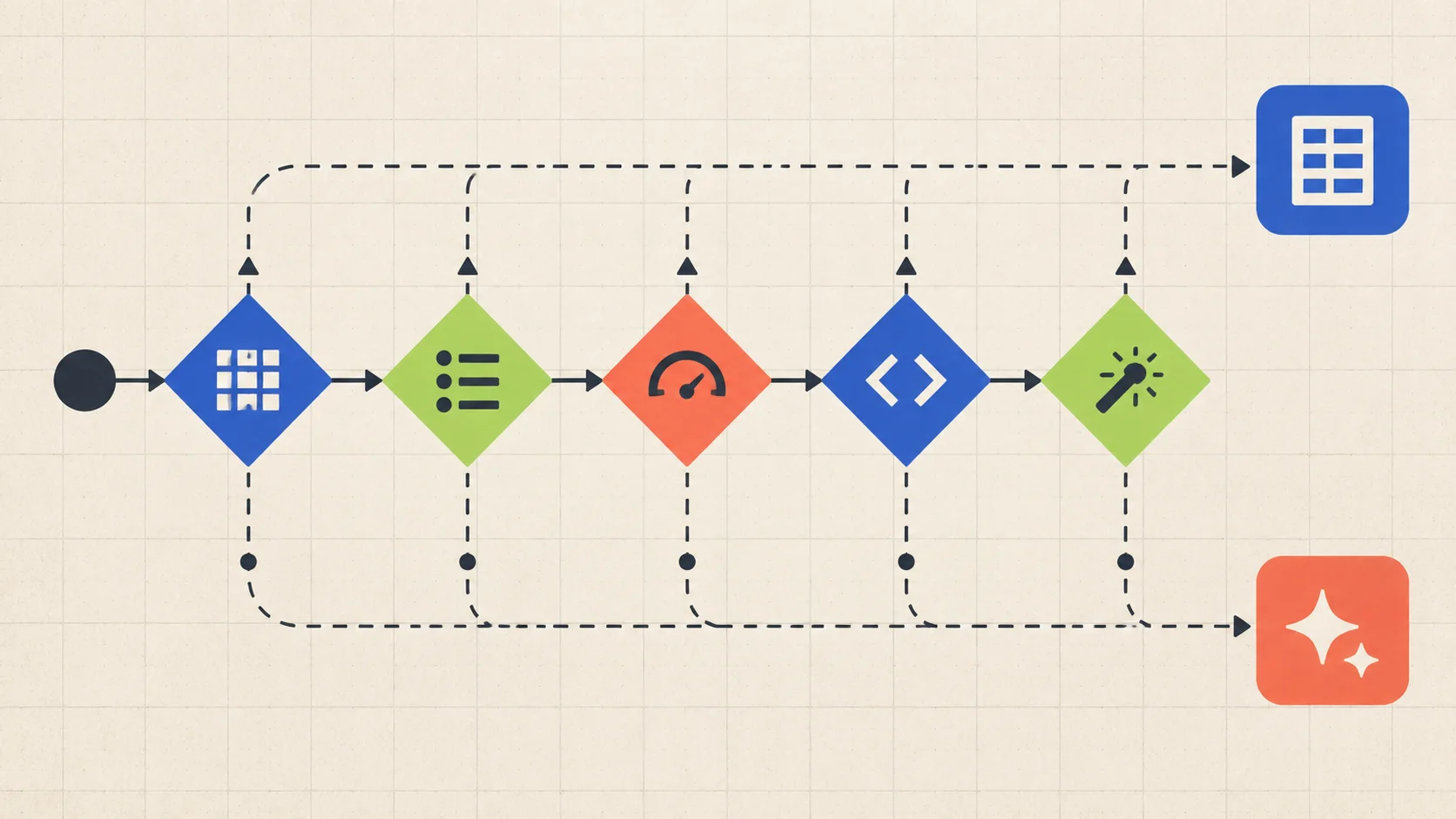
Do not compare ten examples and decide which system “sounds more human.” A useful evaluation measures the final control flow.
Build a representative dataset
Collect normal, borderline, ambiguous, and adversarial inputs. Sample them according to real traffic, and evaluate Chinese, English, specialist terms, and missing context separately.
Measure the cost of each error
Separate false escalation, missed escalation, wrong routing, unsafe execution, and human-review cost. For high-impact actions, accepting more review can be better than optimizing average accuracy.
Compare end-to-end metrics
Track latency, cost, retry rate, parse failures, human-intervention rate, and final task success. Jev’s low latency matters only if it improves the complete workflow.
Evaluate maintainability
Check whether answer spaces are clear, questions can be changed independently, decisions can be replayed, and thresholds remain in code. A system that looks cheap but cannot be explained may cost more over time.
Frequently asked questions
Is Jev AI just a faster LLM?
That is too simple a description. Jev is designed as a System One decision model that returns typed judgments software can use, rather than long-form text. Speed is part of the experience, but you still need to validate it in your environment.
Do I still need Jev if my LLM supports JSON Schema?
Not always. JSON Schema solves many formatting problems. Jev is worth comparing when you need several atomic judgments, probability-based routing, or a stable decision interface inside a high-frequency control flow.
Does Jev replace business rules?
No. Hard rules, permissions, audits, and payment controls should remain deterministic. Jev is most useful for semantic judgments that are difficult to cover with rules but still have a definable answer space.
Can I use Jev without an LLM?
Yes, if your product only needs classification, scoring, routing, and yes/no judgments. If it also needs content generation or open-ended explanations, combine Jev with an LLM.
Where should I start testing?
Open the Jev AI Playground, test one low-risk measurable decision, and then read the API documentation. After the interface works, place Jev in the routing or guardrail layer of your agent.
Conclusion
Choosing between Jev AI and an LLM is not really a question of which model is “smarter.” It is a question of whether your software needs generation or an executable judgment. Give open-ended generation to an LLM, give bounded high-frequency decisions to a decision layer, and keep thresholds and final actions in code.
Research date: 2026-09-20
Primary sources: Jev AI homepage, Jev AI documentation, TypeSafe introduction, Jev AI Showcase